In This Issue....
Featured Inuit Dog Owner: Sandy Hagan
Inuit Dog Thesis 15th Anniversary Edition
Product Review: Delivering the Goods
IMHO: A Few Thoughts about the Final Report on the Dog Slaughters
Navigating
This Site
Index of articles by subject
Index
of back issues by volume number
Search The
Fan Hitch
Articles
to download and print
Ordering
Ken MacRury's Thesis
Our
comprehensive list of resources
Talk
to The
Fan Hitch
The Fan
Hitch home page
ISDI
home page
Editor's/Publisher's Statement
Editor: Sue Hamilton
Webmaster: Mark Hamilton
The Fan Hitch welcomes your letters, stories, comments and suggestions. The editorial staff reserves the right to edit submissions used for publication.
Contents of The Fan Hitch are protected by international copyright laws. No photo, drawing or text may be reproduced in any form without written consent. Webmasters please note: written consent is necessary before linking this site to yours! Please forward requests to Sue Hamilton, 55 Town Line Rd., Harwinton, Connecticut 06791, USA or mail@thefanhitch.org.
This site is dedicated to the Inuit Dog as well as related Inuit culture and traditions. It is also home to The Fan Hitch, Journal of the Inuit Sled Dog.
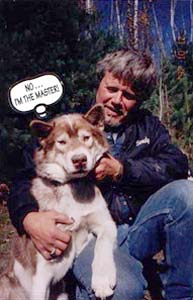
Sandy Hagan with his first ISD, the
irrepressible
red bitch Qidtlak (image as submitted by
owner)
Photo:
Nancy Russell
Sandy Hagan
Stacy, Minnesota, U.S.A.
TFH: How long have
you owned sled
dogs?
S.H.: I have been owned by one or more sled dogs
for over thirty
years. Presently, I am owned by a total of nineteen sled
dogs. Three Alaskan
huskies, two Alaskan-ISD crosses (hand-me-downs as older
dogs), three Alaskan
Malamute-ISD crosses (an accidental breeding), five
Alaskan Malamutes and
six ISDs.
TFH: What breed(s)
did you start
with?
S.H.: My daughter chose the Malamutes on a breed
finding trip
to the library.
TFH: What were you
thinking when
you considered getting ISDs? Why did you want to try
them?
S.H.: I wasn't thinking, obviously. Seriously, I
had reached
a learning point after many years where I could get my
Malamutes to almost
work as a team, and I was very intrigued by ISDs. I was
very curious about
a dog that had been taken from a working environment and
not a show environment.
It was a breed I knew precious little about but enough
that I thought they
should be good working dogs and compliment my Mal team.
Again, it was my
daughter many years after the breed finding trip to the
library that sent
me the information on the available Inuit Dogs.
TFH: So, you are
one of several
mushers who started out with Alaskan Malamutes and
then decided to take
on Inuit Dogs. What were your expectations about
raising, keeping and working
ISDs after owning Malamutes for so long?
S.H.: My expectations weren't as much a factor,
save one, as
my appreciation of the northern breeds and what they were
capable of. Although
I do have three Alaskan huskies and am very impressed with
what they can
do, I consider Mals and Inuit Dogs to be real dogs. Before
I got my first
ISD I did have one strange question that I haven't told
anyone about nor
can I really explain why I had it. Here it is: I wondered
if, considering
the background and how these dogs might've been kept, they
would show any
affection for humans. Yup, I'll admit I'm not too
bright.
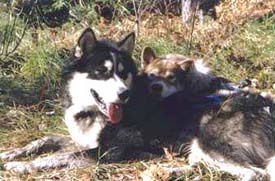
Is Qidtlak merely resting her head or is
she also reminding
Balto who's in
charge?
Photo:
Hagan
TFH: What are your
impressions
of the two breeds' differences? Do you find the ISDs
more or less challenging?
If so in what way?
S.H.: My thoughts on the two breeds are that they
are very similar.
One similarity is that both breeds like to fight. It has
been my observation
that the Mals will fight longer with more of a kill
mindset but the ISDs
are smarter and will fight primarily to assert dominance,
and it's usually
over fairly quickly. Obviously, this is not always true.
The ISDs are more
vocal. Or, I should say, were more vocal. It seems they
have convinced
the entire kennel to be extremely vocal and to scream
whenever someone
or something moves. Bless those ISDs. Both breeds can be
excellent pullers.
My feeling is that Mals have been in the show ring too
long and some of
the work ethic has gone by the wayside. That's not to say
that there aren't
good working Mals around. I know of many and I have had
and still have
some exceptional working Mals. Some breeders do very well
at keeping the
work ethic in their Mals. Both breeds seem to enjoy eating
and, as you
know, that's an understatement.
I find both breeds very challenging. Both breeds are very smart and are oriented toward self-preservation. It has taken them a long time to teach me (and I still sometimes forget) that I get better results from the team as a whole by keeping myself in a good mood and not letting their squabbles reduce me to being angry and making their fights even worse. Both breeds are truly amazing animals. They have an immense amount of stamina and can endure extreme circumstances. They can have a fight, be bloodied, get right back into position beside the dog they just fought with and continue pulling as if nothing happened. Man, I wish I could get over things that quickly.
TFH: Unlike some
mushers who started
out with Alaskan Malamutes, you have not 'abandoned'
that breed. Why?
S.H.: I stuck with Mals because I have had some
exceptional
working Mals. I have a ten-year-old now that can keep up,
his tugline tight,
with the team this year and this is the fastest team I've
had. Time will
tell if he can keep it up but he looks very good now.
TFH: How is your
kennel set up?
What do you feed? Do you alter your dogs' diet
seasonally?
S.H.: My kennel consists of eleven runs and a
fenced exercise
area. The runs are 6 ft x 24 ft (1.6 m x 7.3 m) and the
exercise area is
100 ft x 100 ft (30.5 m x 30.5 m). The dogs get rotated
into the exercise
yard. Each run has one house big enough to house two dogs.
The idea being,
if you want to stay warm and dry, you'll have to try to
get along. I don't
use stake-outs only because we're not in an area that I'd
be comfortable
with using them. I feed National Performance
(http://www.nationaldogfood.com/www/performance.html)
kibble year around and supplement with meat during
training/sledding season.
The dogs get a small amount of fat or meat as a reward at
the end of a
run.
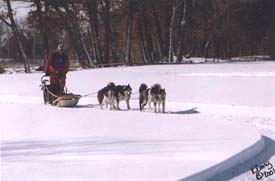
Sandy driving a small team during a
Minnesota Malamute
Club
freight
race
Photo:
Klang
TFH: Do you favor
a particular
kind of harness? If so, why?
S.H.: I'm not as particular about harnesses as I
probably should
be. I use several types. I do watch each dog closely to be
sure that no
harness restricts breathing and that the neck opening
isn't so large that
it will pull against what I call the dog's shoulders. I
equate it to carrying
a yoke with two pails of water on my shoulders. If the
yoke is too big,
my shoulders would get tired and hurt in a hurry. If the
yoke went around
my neck and pulled back, would it choke me? I do have some
of the new,
short shoulder harnesses that I am going to try this
season.
TFH: Describe your
training program
for novice dogs and for your dogs in general at the
beginning of the running
season. Has owning Inuit Dogs changed your training
methods?
S.H.: If the dog is a year old, it gets harnessed,
hitched,
and away we go. My youngest dog, an ISD appropriately
named Hambone, was
just thrown in and away he went. He likes to make his mark
but he's learning
that's not always a real good idea. He's a loose screw but
he's a super
dog. Lead dogs-in-training get put with an established
leader usually without
a neckline. I should add that they've run point for some
time before moving
to lead.
TFH: What kind of
sledding to you
do?
S.H.: In the past, I have done mostly recreational
sledding
with occasional camping trips. I have recently retired and
may do more
camping. On rare occasions, we enter a race. When we do,
we usually get
a comment from the starting line handlers who restrain the
dogs as we go
to the start line that goes something like, "Man, these
dogs must have
had Cheerios for breakfast!" or, "Those are real dogs." I
really just enjoy
being out with the dogs whatever we do. They amaze me,
make me laugh, frustrate
me, teach me, and keep me busy in many ways.
TFH: Now that you
own Inuit Dogs
do you find yourself doing things that you
previously didnít do
and are there things that you don't do now that you
used to do (and this
applies to non-sledding activities as well)?
S.H.: I think that it's not just being owned by
ISDs that has
me doing things that I previously didn't, it's having the
opportunity to
work with critters that are naturally willing to work and
enjoy it. I do
much more sledding and training than I thought I'd ever do
and I'm probably
in better shape mentally and physically because of the
dogs. Well, physically
anyway. One thing we still do but not as much as we used
to is downhill
skiing. We don't travel as much as we used to but that may
change at least
in the summer.
I honestly think that having Inuit Dogs has made sledding easier. They seem to come by the pulling ethic naturally. However, they don't come by the listening and obeying quite as naturally. They want to please but they also sometimes seem to have their own agenda. I'm certainly glad I was fortunate enough to have ISDs as part of my life.
TFH: Has owning
Inuit Dogs impacted
you in ways you would not have predicted?
S.H.: Yes. It has helped me appreciate some of
what I've read
about life as it was and is in the Arctic, it's harshness
and how humans
and animals adapt to and cope with the arctic's extremes.
To this day I
am constantly amazed by the dogs and their ability to work
and stay warm
on very little. I have to feed my Alaskans more food per
body mass to keep
them in working condition. I am amazed by the ISDs
insistence on sleeping
on the snow or roofs of their houses when they have an
insulated (not heated)
floor they can sleep on in what we consider to be frigid
weather here at
-20ºF to -30ºF (-29ºC to -34ºC).
Who would have thought reading Jack London's "Call of the Wild" way back in junior high school would've nudged me in this direction?
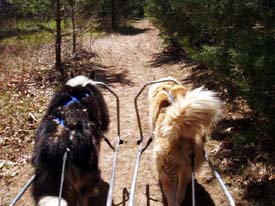
Nimka (l) and Qidtlak (r) out on the
Sacco cart
Photo: Hagan